
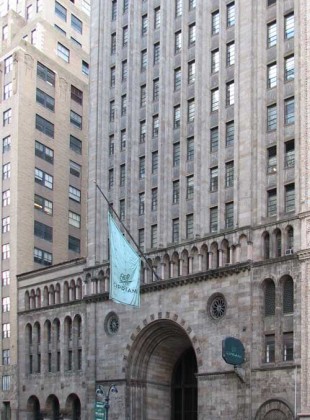
Put York & Sawyer on the list of great unsung architects overdue for a coffee table monograph. Edward York and Philip Sawyer both trained in the office of the legendary McKim, Mead, and White, and, after forming their own firm in 1898, went on to contribute a wonderful body of work to the American Renaissance. Their Bowery Savings Bank, now the home of Cipriani’s, is one of my favorite buildings on 42nd St.
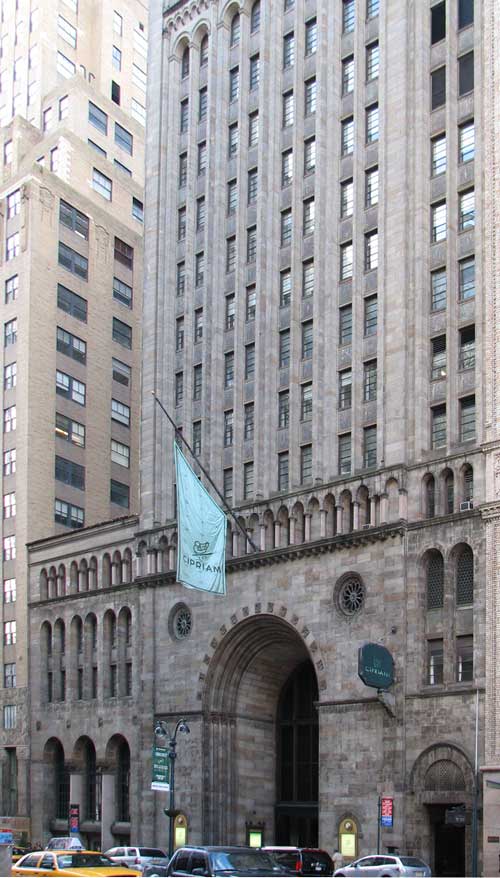
It was completed in 1923, right after the country had bounced quickly back from the relatively unknown depression of 1920. The Romanesque style is an uncommon source of inspiration for this cathedral of commerce, but it’s handled expertly. The facade is asymmetrical out of necessity, yet beautifully balanced. A massive triumphal arch motif marking the principle entrance presides over two smaller scaled local symmetries to the right and left, all stitched together with an arcade across the top. The apparent thickness of the wall as you pass through the great portal lends the facade some serious gravitas. Yet, it manages to convey lightheartedness through the details which are teeming with life and imagination, and, in light of recent events in the world of finance, a touch of irony as well. The text over the arcade reads, “A MUTUAL INSTITUTION CHARTERED 1834 TO SERVE THOSE WHO SAVE.” Those were the days.

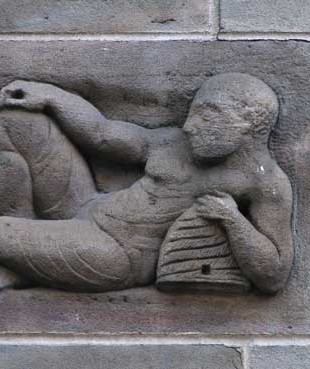
The beehive, emblem of industry.
The selection of stone is superb, with just the right amount of color variation–any more would be too loud, and any less would be too stiff and artificial.
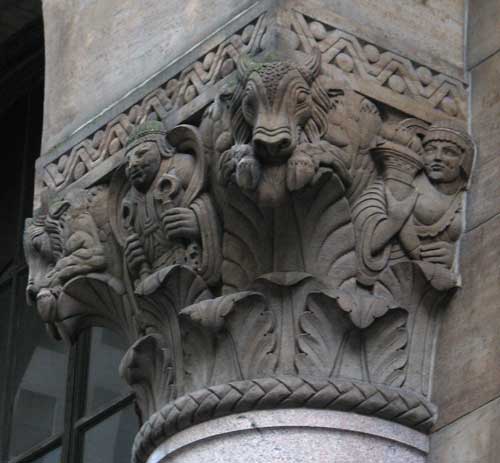
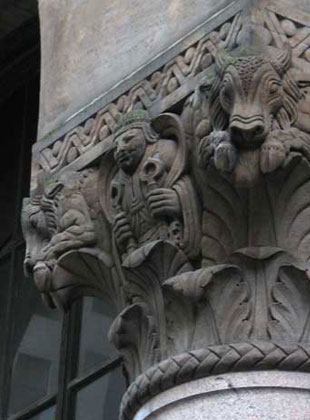
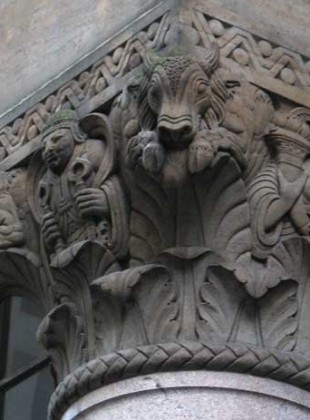
The Art Deco flavor is evident in the marvelous column capitals which adapt standard Corinthian proportions with symbols particular to the banking institution. In this case, the bull symbolizes determination and reliability, the keys, guardianship, and the cornucopia, harvest and abundance. There also seems to be a native quality to the feathered leaves and the braided rope holding them together.
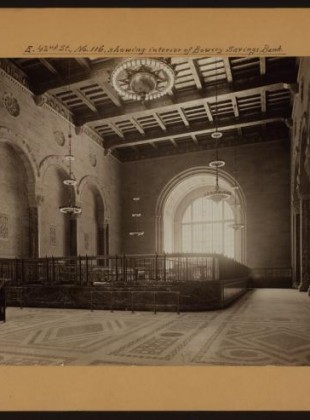
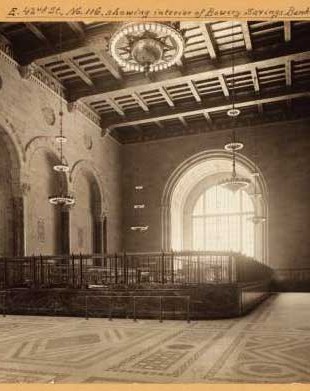
The great hall, now a place for the glitterati to gather, is decorated with an immaculately detailed timber ceiling (unblemished with downlights), truly original chandeliers, and blind arcades of Corinthian columns down the side walls. It’s as though an ancient basilica had been modified for the purpose. Heating and air conditioning is unobtrusive, integrated seamlessly into the architecture.

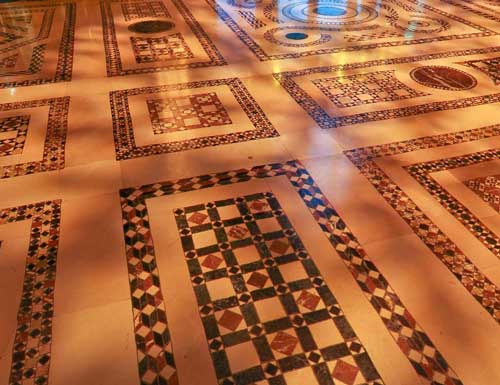
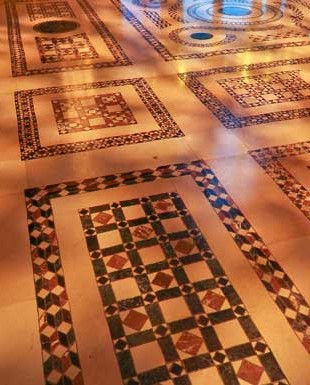
But the pièce de résistance is surely the neo-Cosmatesque floor worthy of a cathedral. The Cosmati were a group of Roman artists who, in the late middle ages, embellished hundreds of churches in the Papal States. The techniques and motifs were themselves revivals from antiquity. (For more on Cosmatesque ornament , consult this book which, as it happens, my wife Paloma authored. And if you’re interested in your own Cosmatesque floor, there are still craftsmen producing them today.)
Here’s a wonderful panorama of the hall to help you get a feel for what it must have been like to deposit a check in the good old days. A far cry from the plastic laminate and acrylic carpet that characterize the experience today.
Thanks. It would be one of my favorites too. Did they intend the cartoon open mouth and eyes? Makes me smile. I didn’t know about neo-Cosmatesque but I sure like “Flat Polychrome Geometric Patterns.” Per Steve Marrtin, “It’s like they’ve got a different word for everything.”
I doubt it was intended, but you never know!
I worked at the Bowery Savings Bank,1965-1981I still remember the first day reporting for work as a teller.I was a young girl from the lower east side. The elegance and beauty of the banking room justtook my breath away…..I was not exposed to such amagnificent setting,You have awaken an older woman’smemories I’m 72…..Mr Marcantonio You have made myday thank you…P.S. Any chance you have photos of theroom,I would gladly pay for them Thanks again
Why is it so darn hard to find your phone # Don”t you like doing bus. on the phone . Please furnish your phone # so I can talk to a human being.This country is going to the dogs. I’ll soon be talking to one on your computer. mf.
Our business number is (212) 765-6606.
The E 42nd St branch was my first job straight out of HS (1970)…..I worked upstairs in the Bank By Mail Dept and always found a reason to go down to the “Banking Floor”…..the architecture….attention to detail is like no other….sorry it was sold to a commercial conglamorate….
Laurie (Heifetz) Gross
went there today and was awed by the interior/exterior. took many pics, it’s haunting and beautiful.
Don’t forget the gorgeous Art Deco ‘Egyptian’ writing desks with lamps that bordered the main banking house. When one was moved to the rear passageway, I inquired about lending it to the Museum of Modern Art for display in their furniture collection.
I came to the U.S. in 1952 from Scotland and worked on Third Ave around 39th St when the El was still up and running and I opened my first savings account in the Bowery Bank on 42nd St, and I was always impressed every time I walked in the door and it made me fell that my money was in good hands with people who cared .
Worked In the Mortgage servicing dept. 1967-70. Got Draft Notice 4/68, Joined National Guard . Got my first taste of drugs 1969 and did not come up for air until 1995.
The best people in the world worked there a highlight of my life.